
Is it premature ejaculation? Definitions, timing and the test.
Most men who search this question are not asking about a minute; they are asking whether what happens to them is a condition, and whether anyone can do anything about it. This guide gives the clinical definition, separates lifelong from acquired PE, explains what the ₩200,000 sensitivity test at our Busan Seomyeon clinic actually measures, and is honest about the men who do not have PE at all.
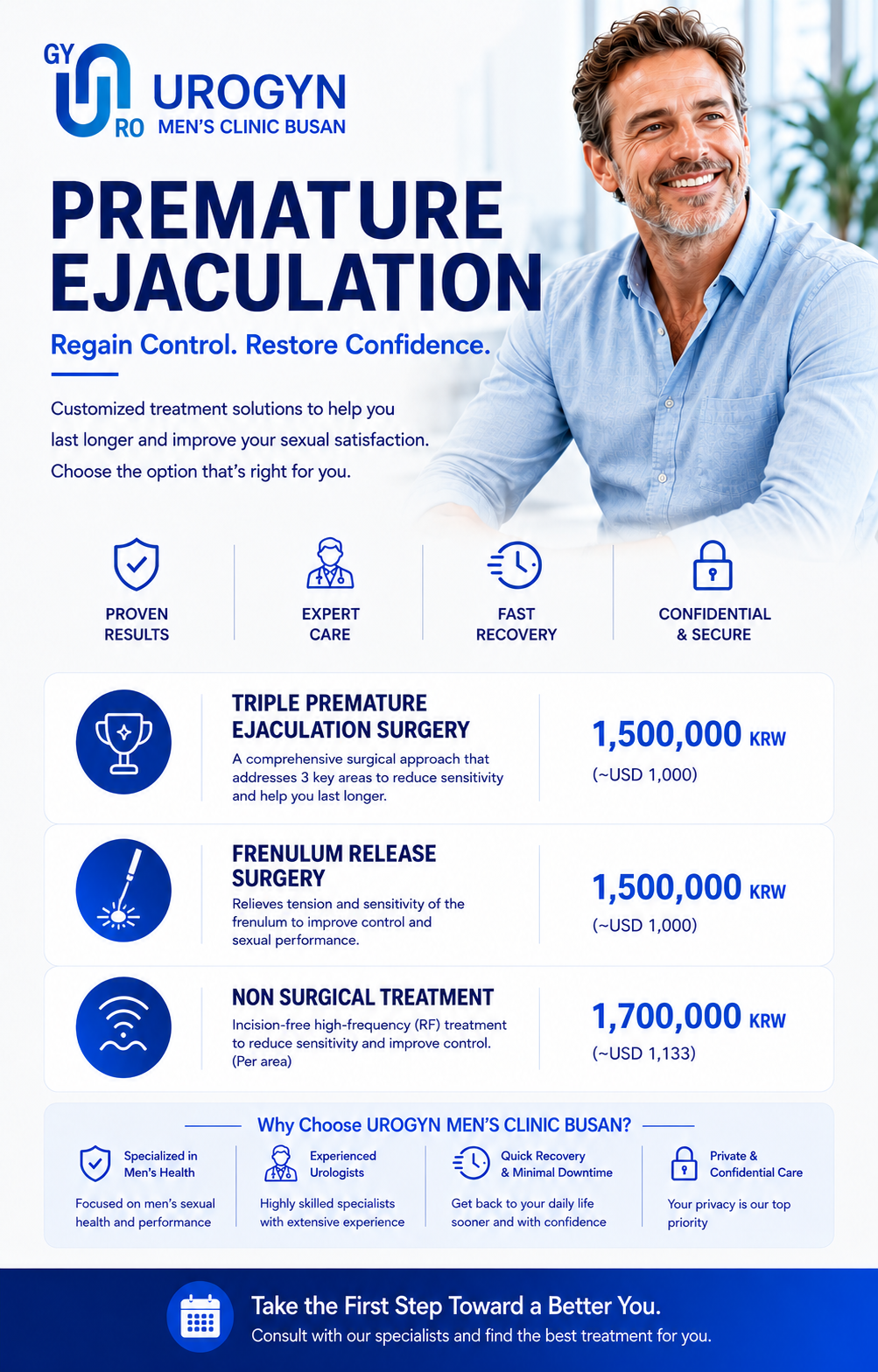
Premature Ejaculation in Busan
The hub behind this guide — non-surgical care, the sensitivity test, RF and the triple nerve block, with every published price.
Read the PE hub →- Is there an actual number of minutes that defines it?
- Does it count if it only happens with a new partner?
- I have always been quick — is that different from it starting recently?
- What does the sensitivity test involve?
- Can PE be caused by something else, like ED or prostatitis?
Each is answered below, the way our PE urologists answer it in the consultation room.
What is the clinical definition of premature ejaculation?
Premature ejaculation is defined by three things together: ejaculation that always or nearly always occurs within about one minute of penetration (lifelong) or that has dropped to about three minutes or less from a previously normal time (acquired); an inability to delay it on all or nearly all occasions; and personal distress or avoidance of intimacy because of it. All three are required. At Urogyn Men's Clinic in Busan Seomyeon the diagnosis is made from that history, and the ₩200,000 sensitivity test then establishes whether over-sensitivity is the mechanism — which decides the treatment.
The definition matters because it excludes a great deal. A man who lasts four minutes and wishes it were ten does not have PE. A man who is quick with a new partner and normal with a familiar one has a situational issue, not a condition. And a man with no distress has nothing to treat. The PE hub covers the treatment options; this page is about whether they apply to you.
The three parts of the definition
- 1 Time. Lifelong: within about one minute, from the first sexual experiences. Acquired: a clear reduction to about three minutes or less in a man who previously lasted longer. The thresholds are guides, not stopwatches.
- 2 Control. Inability to delay ejaculation on all or nearly all occasions. A man who can sometimes delay and sometimes cannot is describing variability, which is normal.
- 3 Distress. Frustration, avoidance of sex, relationship strain. Without this, there is no condition — only a fact about timing that the man is content with.
Lifelong versus acquired: why the distinction changes everything
Present from the first sexual experiences, with every partner. Often a genuinely low sensitivity threshold — the pattern most likely to show on the test and most likely to benefit from RF or a nerve block.
Developed after years of normal timing. More often driven by anxiety, a new relationship, erectile difficulty, prostatitis or thyroid disease — the causes are looked for and treated, and a nerve block is rarely the answer.
This is the single most important question the urologist asks, because it steers the whole plan. A man with lifelong PE and a low threshold on testing is a candidate for the triple nerve block at ₩1,500,000. A man with acquired PE is examined for what changed — and usually finds that treating it restores his timing without any nerve treatment at all. The nerve block vs non-surgical guide explains the two roads.
What is not premature ejaculation?
- Normal variability. Timing varies with arousal, novelty, interval since last ejaculation and fatigue. Being quick sometimes is not a condition.
- Subjective PE. A man with normal or long timing who nonetheless feels it is too fast. Real distress, but not treated with sensitivity reduction — that would remove sensation without changing the perception.
- Situational timing. Quick with a new partner, normal with a familiar one; or quick only in certain circumstances. An anxiety pattern, addressed as one.
- Ejaculation before or without an erection. Sometimes described as PE but often a sign of erectile difficulty — a man hurrying because he fears losing the erection. Treated as ED first.
- A long time since the last ejaculation. Timing after abstinence is short in most men; it is not diagnostic.
Non-Surgical PE Treatment in Busan
Topical anaesthetics, the ₩200,000 sensitivity test and non-incisional RF — the road most men start on once the diagnosis is made.
Read the non-surgical page →How is it measured — and why the stopwatch is not the point
Researchers — and the urologists at our Busan clinic when it helps — measure intravaginal ejaculatory latency time — the interval from penetration to ejaculation, timed by the couple — and population studies put the median in the range of five to six minutes with wide variation. Clinically the number is useful as a rough anchor for the “one minute” and “three minute” thresholds, but urologists do not diagnose from a stopwatch. They diagnose from the pattern: since when, with whom, how consistently, how much control, how much distress. A man can bring a timed estimate if he has one; he should not feel he needs to time himself to be taken seriously.
What does the ₩200,000 sensitivity test at our Busan clinic measure?
Penile sensitivity is measured objectively at several points — shaft, glans, frenulum — to establish the threshold at which sensation is registered and whether it is abnormally low, and to map where the sensitivity is concentrated. It does not measure time and it does not diagnose PE; the history does that. What it does is answer the treatment question: a man with PE and a normal threshold will not benefit from reducing sensitivity and is treated with technique, topical care and attention to cause; a man with PE and a low threshold, especially lifelong, is a candidate for RF at ₩1,700,000 per area or a nerve block at ₩1,500,000, targeted to where the test shows the sensitivity lies. The test is why our Busan clinic does not perform a nerve block on a man who has not had one.
Causes worth checking at our Busan clinic
- Erectile difficulty. The commonest hidden driver of acquired PE — a man hurries before the erection fades. The ₩400,000 ED first visit with response test, when the history suggests it.
- Prostatitis. Chronic pelvic inflammation is associated with acquired PE; a urine test at ₩200,000 and examination find it. The pelvic pain guide explains.
- Thyroid disease. An overactive thyroid is a recognised cause; checked on the ₩500,000 full hormone panel when symptoms fit.
- A short frenulum. Tugging at the glans during sex; treated with frenulum release, which sometimes resolves PE on its own.
- Anxiety and relationship factors. Not tested for — asked about, and taken seriously.
What follows the diagnosis?
If it is not PE: an explanation from the urologist in Busan, reassurance with numbers, and — where anxiety is the driver — a plan for that. If it is acquired PE: treatment of the cause found, with technique guidance and, where useful, a topical anaesthetic; a nerve block is rarely offered. If it is lifelong PE with a low threshold: the two roads laid out in the comparison guide — sprays and RF on the reversible side, the triple nerve block on the permanent side — with the trade-offs stated and the choice yours. Every step is priced from the published list, and nothing irreversible is done on a first visit without the test behind it.
How it runs at our Busan Seomyeon clinic — and your next step
Message us with your travel dates and the three parts of the definition in your own words: roughly how long, since when — always or recently — how much control, and how much it bothers you; plus whether erections are reliable, whether you have pelvic discomfort, and what you have tried. You will receive a reply in English with the urologist's honest provisional view — PE or not, lifelong or acquired — the ₩200,000 test confirmed, and any cause he expects to check with its published price. On the day, the same doctor takes the history, tests, explains and plans. For the treatment options, start with the PE hub; for the figures, the full price list.
- Does the sensitivity test hurt? No. It measures the threshold at which sensation is registered using a calibrated stimulus; it is brief and not painful, and it is done in the consultation room with the urologist alone.
- Can PE and ED both be present? Yes, and often — a man hurries because his erection is unreliable, then loses the erection because he is anxious about timing. The urologist assesses both, and the ED is usually treated first because it frequently resolves the PE.
The urologists who perform your vasectomy.
Every guide on this site is written and reviewed by the three board-certified urologists below. The doctor who consults with you is the doctor who operates and answers your follow-up — never a junior doctor or a different surgeon.



Is it premature ejaculation — FAQ
Related pages and next reads
Premature Ejaculation in Busan
The hub — every option and every published price.
Nerve Block vs Non-Surgical PE
The two roads after diagnosis, and who suits which.
Non-Surgical PE Treatment
Sprays, the sensitivity test and RF.
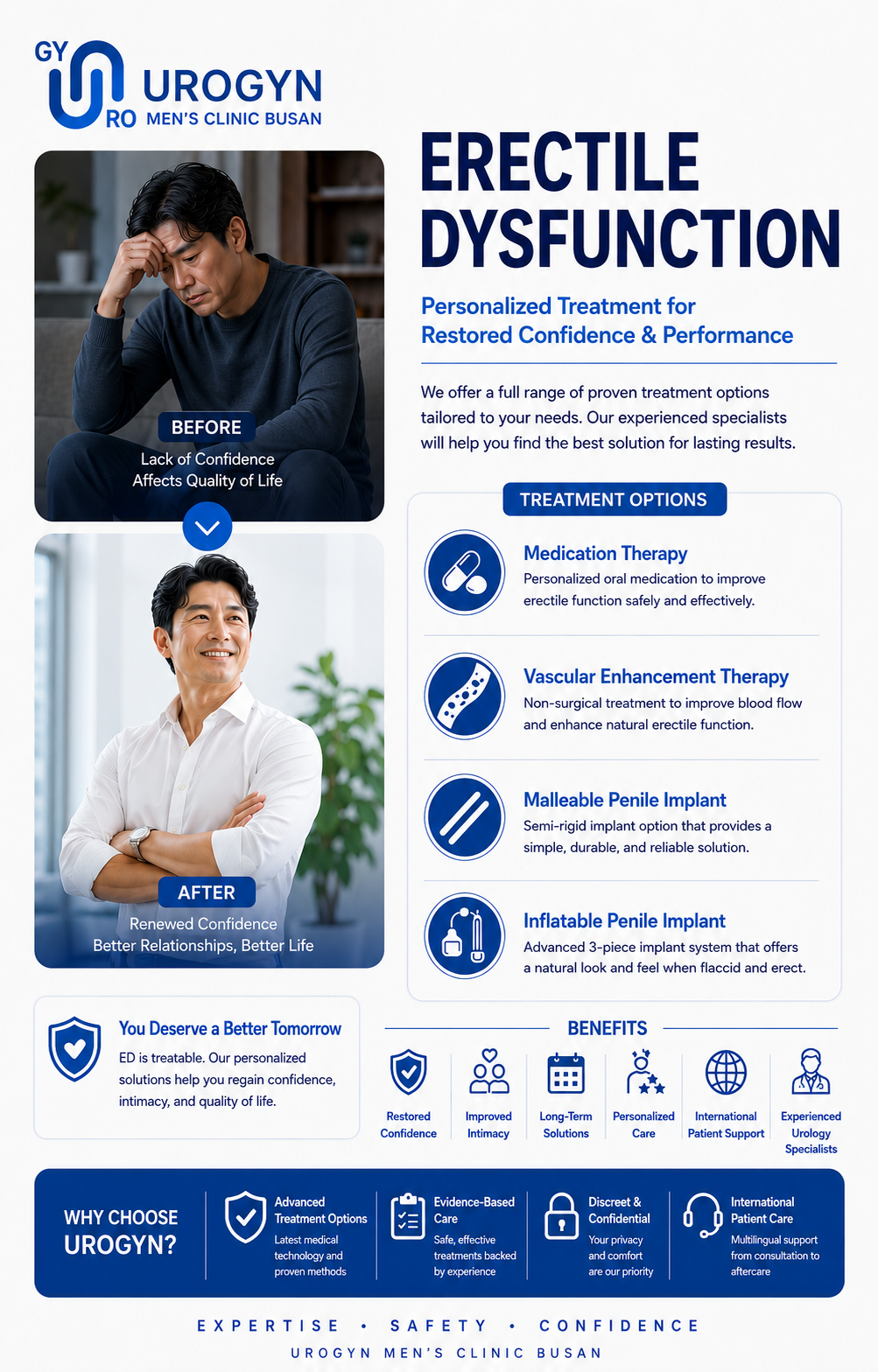
Erectile Dysfunction in Busan
The hidden driver of acquired PE — treated first.

Chronic Pelvic Pain in Men
Prostatitis as a cause of acquired PE.

Frenulum Release in Busan
When a short frenulum is the cause — a small procedure that sometimes resolves it.
Urogyn Men's Clinic, Seomyeon
7F-702, Ion City Building, 74 Seomyeon-ro, Busanjin-gu, Busan 47299 — one minute on foot from Seomyeon Station Exit 7 (Lines 1 & 2).
Mon–Fri 10:00–18:00 · Sat 10:00–14:00 · Sun closed
부산광역시 부산진구 서면로 74 아이온시티빌딩 7층 702호 — show this to your taxi driver.
Describe the pattern, not the minutes. Then take the test.
Your dates and the three parts of the definition in your own words — how long, since when, how much control, how much distress — are enough for an honest written view and a ₩200,000 test booking, in English, from the PE urologist who would see you at our Busan Seomyeon clinic.