
Laser vs stapler circumcision for adults, compared honestly.
Two modern techniques for the same operation, each with a real case behind it. Laser circumcision is the standard at our Busan Seomyeon clinic — basic from ₩800,000 — and this guide explains why, by comparing the two on bleeding, scar line, healing time, adjustability and cost, without pretending either is the only right answer.
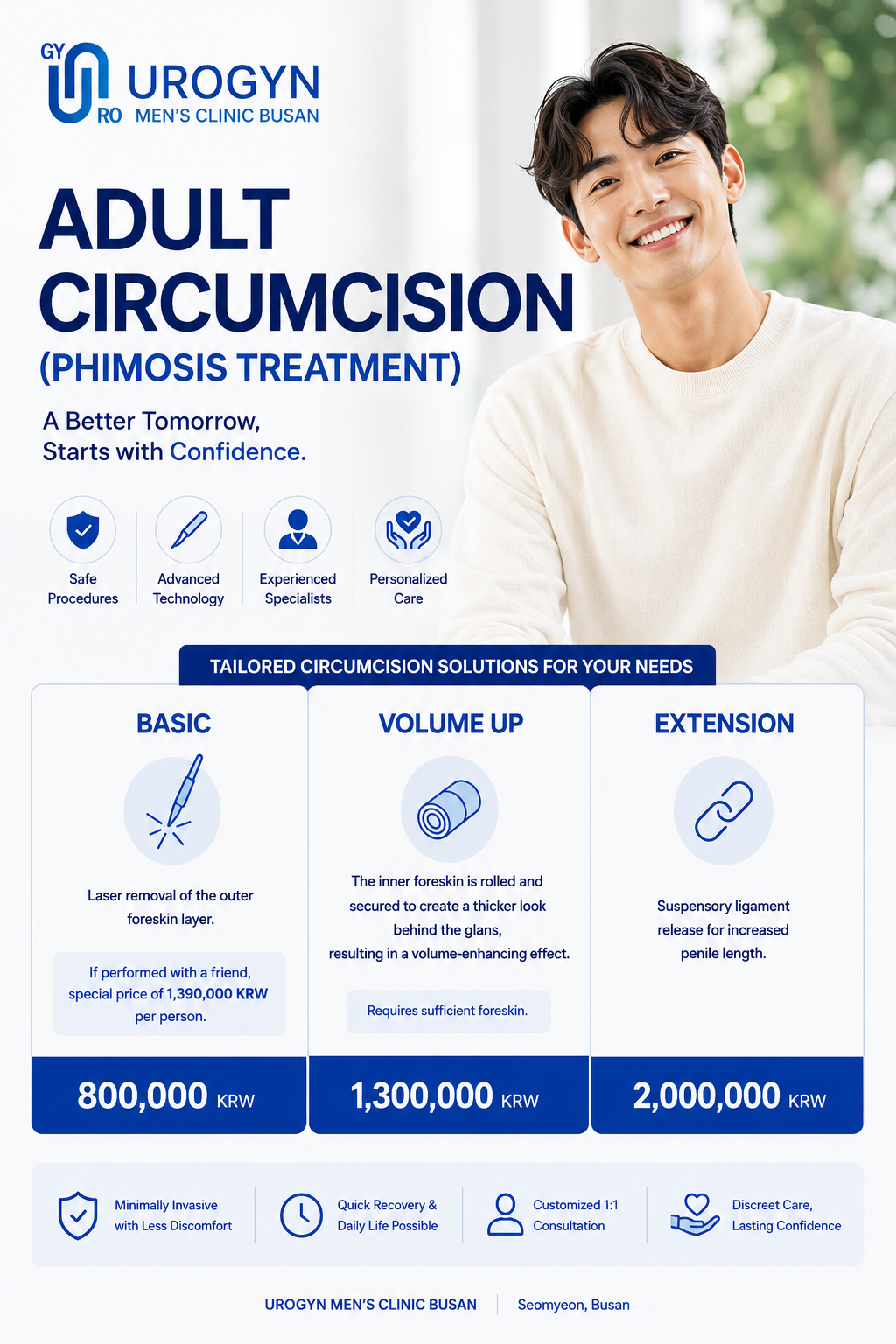
Adult Circumcision in Busan
The clinical page behind this comparison — the laser technique, three options, phimosis treatment and week-by-week recovery, with published prices.
Read the circumcision page →- Is stapler circumcision faster and less painful than laser?
- Which leaves the neater scar?
- Do staples have to be removed later?
- Can the surgeon adjust how much skin is removed with a stapler?
- Why does Urogyn use laser as its standard?
Each is answered below, the way our urologists answer it in the consultation room.
How do laser and stapler circumcision each work?
Laser circumcision uses a surgical laser to cut and seal the foreskin in one pass, followed by a hand-placed suture line — the technique used for adult circumcision at Urogyn Men's Clinic in Busan Seomyeon, listed from ₩800,000. Stapler circumcision uses a disposable circular device that cuts the foreskin and places a ring of small metal staples in the same action, replacing hand suturing. Both remove the same tissue under local anaesthesia — see the procedure page; they differ in how the edge is sealed, how it heals, and how much the surgeon controls the result.
Neither is old-fashioned and neither is a gimmick — both are established, and the choice between them is about the trade-offs below. The circumcision page covers the laser procedure in full; this page is the comparison.
Precise cutting with immediate sealing of small vessels. Surgeon controls the line by hand. Absorbable sutures.
Device does the cutting and closure simultaneously. Fast; metal staples remain until they shed or are removed.
Bleeding and the procedure itself
Both techniques are low-bleeding compared with a plain scalpel, for different reasons. The laser seals small vessels as it cuts, so the field stays dry and the surgeon sees the tissue clearly; hand suturing then closes the edge with control over tension. The stapler compresses the edge with its ring of staples, which is also haemostatic, and the whole closure takes a matter of minutes — the reason stapler circumcision is marketed as fast. In practice the difference in operating time is modest for an experienced surgeon, and both are same-day procedures under local anaesthesia at our Busan clinic, with the urologist speaking to you in English throughout.
Which leaves the neater scar line — and why laser is our Busan standard?
This is where opinions divide, and the honest answer is that both can be neat and both can be untidy, depending on the surgeon and the healing. Laser with hand suturing produces a fine line whose position and evenness the surgeon sets stitch by stitch; it can be adjusted for asymmetry on the table. Stapler closure produces a uniformly even line by design — the device places the staples at fixed intervals — but the ring of small marks left by the staples can persist as a dotted pattern in some men before fading, and the line's position is fixed by where the device is seated rather than chosen point by point. Our urologists' preference for laser rests largely on that second point: control.
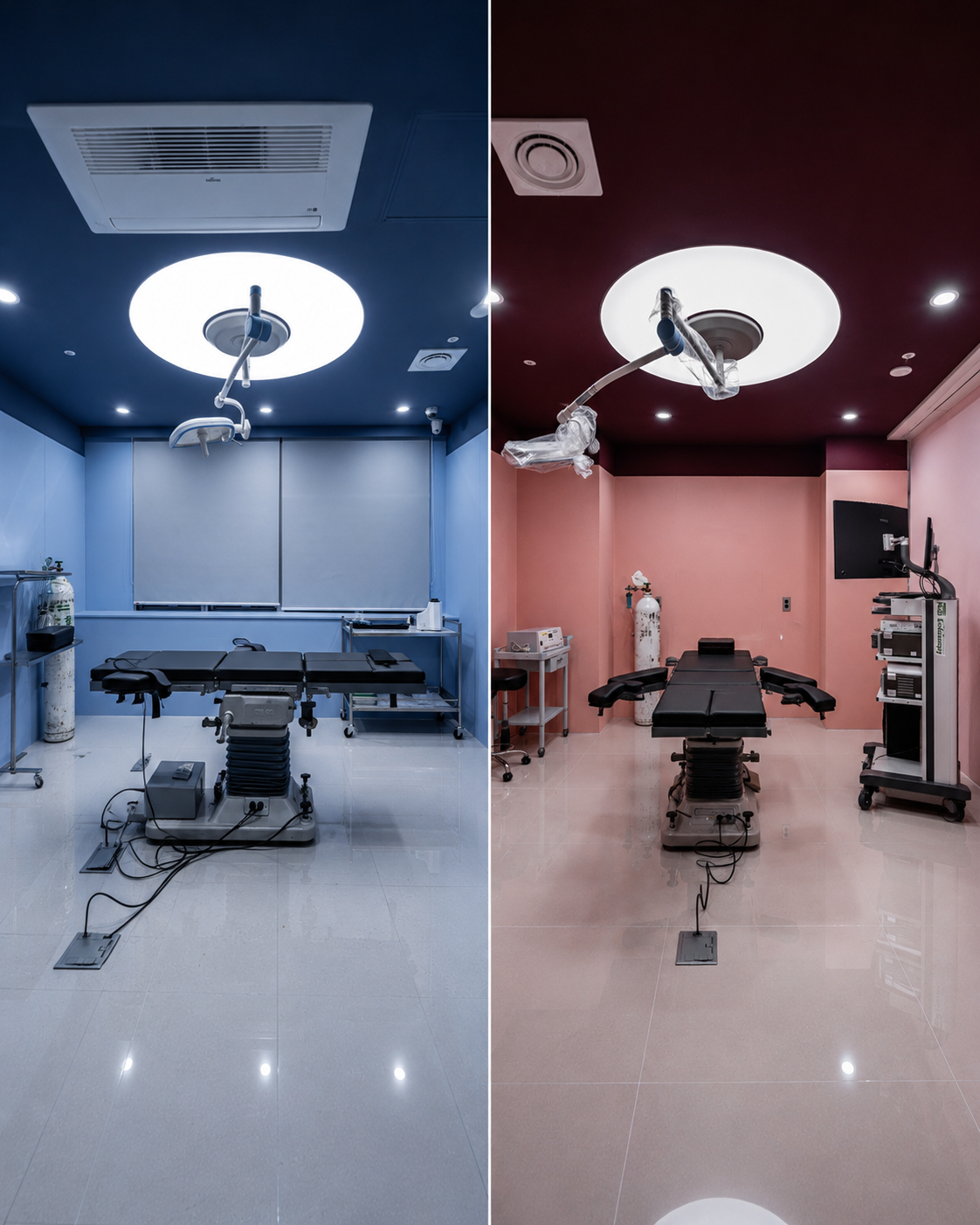
Laser circumcision at Urogyn, Seomyeon
Performed here under local anaesthesia in the clinic's own procedure room by a board-certified urologist — same-day, with hand-sutured closure.
How the laser procedure works →Healing time and the staples question
Laser circumcision closed with absorbable sutures heals along a conventional path: the sutures dissolve over a few weeks, swelling settles over the first fortnight, and the line matures over months. Nothing needs removing. Stapler circumcision leaves a ring of metal staples in place; they are designed to shed as the tissue heals, typically over two to four weeks, but a proportion do not shed on their own and must be removed at a follow-up visit — a practical problem for an international patient who has already flown home. That single logistical point, more than any clinical one, is why our urologists in Busan consider stapler circumcision a poorer fit for men who cannot return.
- 1 Laser: first week. Swelling, night erections uncomfortable. Sutures in place, nothing to remove.
- 2 Laser: weeks two to four. Sutures dissolve; line settles. Sexual activity waits until the urologist confirms — usually around four to six weeks.
- 3 Stapler: weeks two to four. Staples shed or are removed. Retained staples need a clinic visit — plan for it if you choose this technique anywhere.
Adjustability: skin amount and glans exposure
Adult circumcision is not one operation but a spectrum: how much inner and outer foreskin to remove, how high or low to set the line, and how the frenulum is handled all change the result. Laser with hand suturing lets the surgeon set each of these individually and adjust on the table — which is what makes the volume-up and extension options at ₩1,300,000 and ₩2,000,000 possible, since both rely on that control. A stapler removes a fixed cuff determined by the device size and seating; it is excellent for a standard result and less suited to men who want a specific line, a particular frenulum outcome, or a cosmetic addition. Men with phimosis, a short frenulum or prior scarring benefit most from the adjustability.
Cost in Busan: what does each include?
At Urogyn the laser procedure is published at ₩800,000 basic, ₩1,300,000 volume-up and ₩2,000,000 extension, performed by a urologist with absorbable sutures and message-based follow-up; the circumcision cost guide itemises all three. Stapler circumcision, where offered, carries the cost of a single-use device, which clinics price in different ways — sometimes as a headline figure that looks lower, sometimes with the device billed separately. The comparison to make anywhere is not the headline but the total including the device, the closure and any follow-up visit for staple removal. On that basis the two are usually closer than the marketing suggests.
Who suits which technique?
- Laser — men who want the surgeon to control the line; men with phimosis, a short frenulum or prior scarring; men choosing a cosmetic addition; and international patients who cannot return for staple removal. The standard at our Busan clinic for these reasons.
- Stapler — men who want a standard result quickly, can attend a follow-up visit locally, and have straightforward anatomy. A reasonable choice at a clinic experienced with the device.
- Either, done well — beats either done badly. Surgeon experience with the chosen technique outweighs the technique itself, which is why the operating urologist is the first thing to ask about anywhere.
What does neither technique change?
Three constants. Both leave a scar — a fine line, but a line — and men who expect an invisible result should hear that before paying. Both need the same aftercare: a quiet first week, uncomfortable night erections, and a wait of several weeks before sexual activity, as the circumcision page sets out honestly. And neither changes size, sensation or function beyond the removal of the foreskin itself; claims that one technique improves sensitivity or performance describe hopes, not outcomes. What does change is the care around the procedure — who operates, how the line is set, and who answers your message on day nine.
How it runs at our Busan Seomyeon clinic — and your next step
Message us with your travel dates, whether you have phimosis, a tight frenulum or a prior circumcision, and — if you are comfortable — a photograph, which stays with the urologist only. You will receive a reply in English confirming the laser procedure that fits, its published price, and how long to plan in Busan. On the day, the same doctor consults, operates with hand-sutured closure, and answers your messages through the weeks that follow — with nothing to remove. For the procedure detail, start with the adult circumcision page; for every figure, the full price list.
- I had a stapler circumcision elsewhere and some staples are still there. Can Urogyn remove them? Yes — retained staples are removed at consultation, and the line is assessed at the same time. If the scar needs revision, the scar revision page explains what is possible.
- Is there a sleeve or other technique besides these two? The sleeve technique is a variant of hand-sutured circumcision that removes a cuff of skin while preserving the inner layer; at Urogyn it is performed with the laser where the anatomy suits it, and the urologist will say whether it applies to you at consultation.
The urologists who perform your vasectomy.
Every guide on this site is written and reviewed by the three board-certified urologists below. The doctor who consults with you is the doctor who operates and answers your follow-up — never a junior doctor or a different surgeon.



Laser vs stapler circumcision — FAQ
Related pages and next reads
Adult Circumcision in Busan
The laser procedure, three options, phimosis and recovery.

Circumcision Cost Guide
Basic, volume-up and extension itemised, plus the friend rate.
Penile Scar Revision
Z-plasty for tethered or uneven scars from circumcision elsewhere.

Frenulum Release in Busan
Often handled in the same procedure when the frenulum is short.
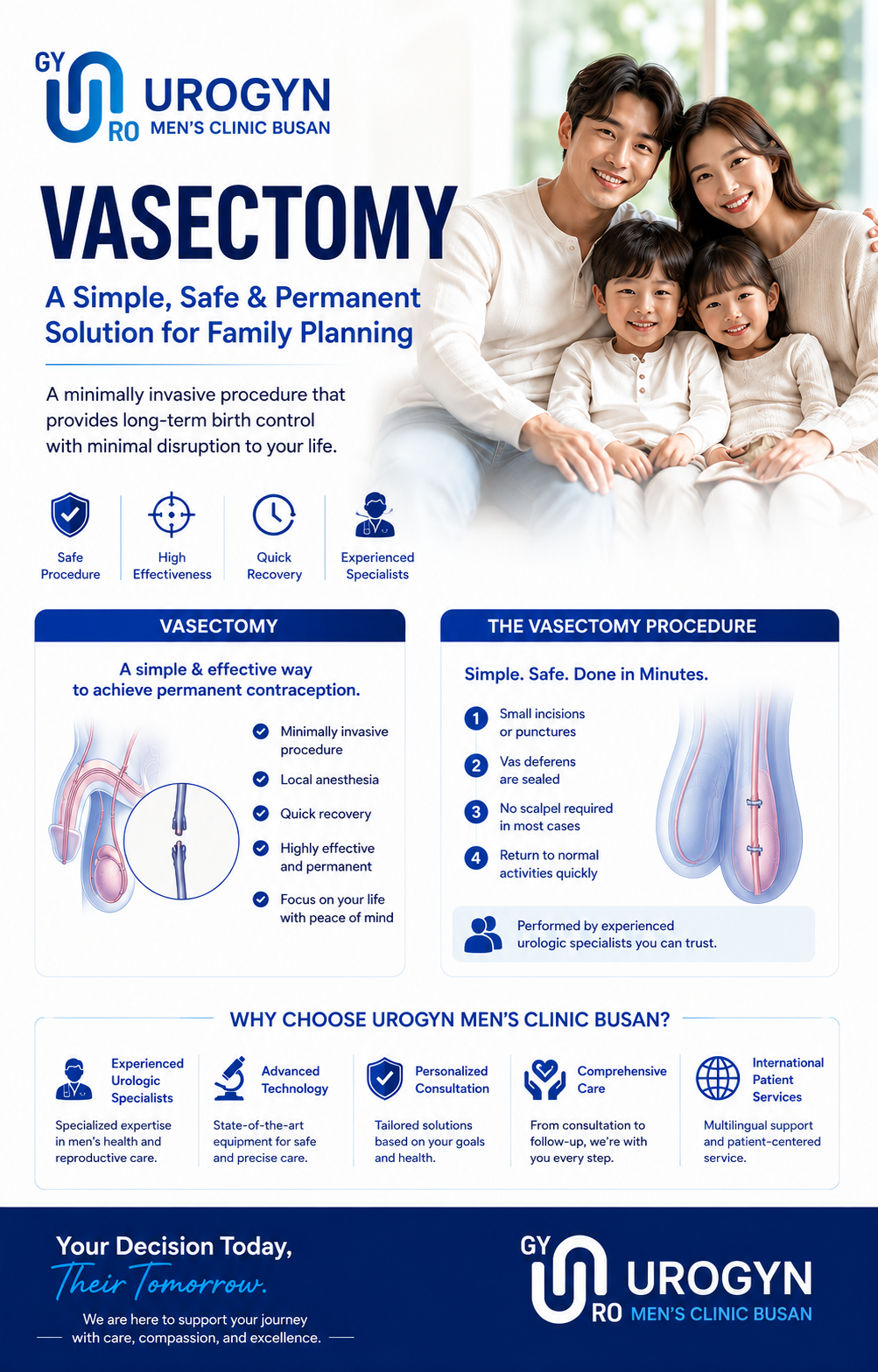
Vasectomy in Busan
Sometimes planned on the same trip — the five-layer technique explained.

International Patients Guide
Routes, hotels near Seomyeon and how a same-day trip is planned.
Urogyn Men's Clinic, Seomyeon
7F-702, Ion City Building, 74 Seomyeon-ro, Busanjin-gu, Busan 47299 — one minute on foot from Seomyeon Station Exit 7 (Lines 1 & 2).
Mon–Fri 10:00–18:00 · Sat 10:00–14:00 · Sun closed
부산광역시 부산진구 서면로 74 아이온시티빌딩 7층 702호 — show this to your taxi driver.
Send your dates. Nothing to remove afterwards.
One message with your travel dates and a few screening answers is enough for a same-visit laser circumcision plan at our Busan Seomyeon clinic — in English, from the urologist who will operate and follow up.