
Blood in semen or urine: what it usually is, and what a Busan check-up rules out.
Blood where it should not be is alarming and, most of the time, benign. Blood in semen in a man under forty is nearly always harmless and self-limiting; blood in urine deserves more respect, especially over fifty. This guide from Urogyn, Busan Seomyeon, separates the two, lists the common causes, and explains what the ₩200,000 urine test and ultrasound are looking for.

Men's Health Clinic in Busan
The hub behind this guide — urine testing, STI panels, prostate and scrotal ultrasound under one roof in Seomyeon.
Read the men's health hub →- I saw blood in my semen once and it went away — do I need to do anything?
- The blood in my urine stopped after a day. Is that reassuring?
- Could this be an STI even though I have no other symptoms?
- What exactly does the urine test show that I cannot see?
- I am on blood thinners — is that the explanation?
Each is answered below, the way our urologist answers it at the Seomyeon clinic — with the two symptoms kept carefully apart.
The short answer: two symptoms, two different levels of concern — as assessed in Busan
Blood in semen (haematospermia) in a man under forty, with no other symptoms, is almost always benign — a small vessel in the prostate or seminal vesicles, often after vigorous or infrequent ejaculation — and usually clears within a few weeks. Blood in urine (haematuria), visible or found on a dipstick, is taken more seriously at Urogyn in Busan Seomyeon: most causes are infection, stones or prostate enlargement, but a bladder or kidney tumour has to be excluded, particularly in men over fifty and smokers. The ₩200,000 urine test and ultrasound start both work-ups.
The practical rule is simple. One episode of blood in semen in a younger man: come in if it recurs, or sooner if there is pain, fever or urinary symptoms. Any episode of visible blood in urine: come in, even if it has stopped, because haematuria is often intermittent and the absence of pain is not reassuring. The men's health hub lists the tests; the sections below explain what each is for.
Under 40, single episode, no other symptoms → observe. Recurrent, over 40, or with symptoms → urine test, STI panel, prostate ultrasound.
Any visible episode, even once and painless. Urine test and culture, ultrasound of kidneys, bladder and prostate; referral for cystoscopy over 50 or with risk factors.
Blood in semen: the causes a Busan urologist expects
The seminal vesicles and prostate are richly supplied with small vessels, and one of them bleeding into the ejaculate is the commonest explanation — brownish or red streaks in semen that fade over a few ejaculations. Inflammation of the prostate or seminal vesicles comes next; our prostatitis page covers the types, and painful ejaculation often travels with it. Sexually transmitted infection, particularly chlamydia and gonorrhoea, can present this way in younger men. Less commonly, a recent prostate biopsy, a stone in the ejaculatory duct, or anticoagulant medication. In men over forty, or with persistent bleeding, prostate assessment including PSA is added — not because cancer commonly presents with blood in semen, but because the examination is the same.
- 1 Single episode, under 40, no symptoms. Observe. Come in if it recurs beyond a few weeks.
- 2 Recurrent or with pain, fever, urinary burning. Urine test ₩200,000, STI panel ₩250,000, prostate ultrasound ₩200,000.
- 3 Over 40 or persistent beyond a month. Add PSA ₩150,000 and a full prostate assessment.
Blood in urine: why every episode is assessed
Urinary infection is the commonest cause and usually comes with burning and frequency. Kidney or bladder stones cause pain in the flank or lower abdomen and blood that comes and goes. Benign prostate enlargement bleeds from fragile surface vessels, particularly after straining; our BPH signs guide covers the symptoms that go with it. Vigorous exercise, especially long-distance running, causes transient haematuria. And then the cause that has to be excluded: bladder cancer, which in its early stages causes painless, intermittent visible blood and nothing else. It is more common over fifty and in current or former smokers, and it is very treatable when found at that stage. This is why "it stopped, so it must be fine" is the wrong conclusion.
What the ₩200,000 urine test and the ultrasound look for
The urine test at our Seomyeon clinic does three things: confirms that it is actually blood (some foods and medications colour urine), looks for infection and inflammation, and examines the red cells and any other cells under the microscope. A culture identifies the bacterium if infection is found. The ultrasound — kidneys, bladder and prostate for haematuria; prostate and seminal vesicles for haematospermia — looks for stones, masses, prostate size and bladder wall thickening, and checks the bladder empties. Together they explain most cases. For haematuria in men over fifty, or with risk factors, cystoscopy — a camera inspection of the bladder — is the definitive test and is done at a hospital, to which we refer with the full work-up.

Dr. Kim Jin-seong — general and prostate urology
Director of the Busan branch, board-certified urologist, Gyeongsang National University, adjunct clinical professor at GNU Hospital. Performs the urine and ultrasound work-up at the Seomyeon clinic and refers for cystoscopy when indicated.
Read the men's health hub →The STI question: why it is asked even when it feels unlikely
Chlamydia and gonorrhoea can inflame the urethra, prostate and epididymis and produce blood in semen or urine with few other symptoms. The ₩250,000 thirteen-panel test at our Busan clinic settles it from a urine sample and is asked for routinely in younger men with either symptom, regardless of what they expect the answer to be — because a negative result removes a cause and a positive one is simply treated. Our STI testing page covers the panel and the window periods, and the STI symptoms guide explains timing.
Anticoagulants, exercise and other things that are not the cause but reveal it
Men on blood thinners sometimes assume the medication explains the blood. It does not; it lowers the threshold at which an underlying cause becomes visible, and the work-up is the same. The same applies to the haematuria of long-distance runners: usually benign, but a first episode is assessed once rather than assumed. Tell us what you take and what you do, because it changes the interpretation but not the need to look.
What the colour and timing tell a Busan urologist before any test
Before the urine test, the description itself narrows the field. Blood at the very start of the stream that clears points to the urethra or prostate; blood throughout the stream points to the bladder or kidneys; blood only at the end points to the bladder neck or prostate. Bright red suggests fresh bleeding; dark or brown, older blood or a bleed higher up; clots, a heavier source that needs faster assessment. For semen, brownish streaks are older blood from the seminal vesicles and are the typical benign pattern, while bright red semen suggests a more recent or more active source. None of this replaces the test, but it is why we ask you to describe exactly what you saw, and why a photograph of the urine in the bowl — unglamorous as it is — is genuinely useful when you message our Seomyeon clinic.
Fitting the work-up into a trip to Busan
Urine test, culture, STI panel and ultrasound can all be done in one morning visit at our Seomyeon clinic, with most results the same or next day and the culture within a few days. If infection is found, treatment starts immediately. If the finding is a stone or prostate enlargement, the plan is made in the room; the prostate hub covers the BPH path. If cystoscopy is indicated, we refer to a Busan university hospital or provide the complete work-up in English for a hospital at home. Our records and prescriptions guide covers what you take with you.
How it runs at our Busan Seomyeon clinic — and your next step
Message us with which it is — semen, urine or both — when you first noticed it, whether it has recurred, any pain, fever or urinary symptoms, your age, whether you smoke, and your medication. We reply in writing with how soon to be seen and which tests we would do on arrival. Nothing is booked until you confirm and no deposit is taken. The clinic is one minute from Seomyeon Station exit 7; the contact page has directions.
- Can prostate cancer cause blood in semen? Rarely, and it is not a typical presentation. In men over forty with recurrent haematospermia we add PSA and a prostate assessment because the examination is the same, not because cancer is the expected finding.
- Does cycling cause blood in urine? Vigorous or prolonged exercise can cause transient haematuria. A first episode is assessed once with the urine test and ultrasound; if nothing is found and it recurs only after exercise, it is usually left at that.
The urologists who investigate blood in semen or urine in Busan.
Every guide on this site is written and reviewed by the three board-certified urologists below. The doctor who consults with you is the doctor who operates and answers your follow-up — never a junior doctor or a different surgeon.


Blood in semen or urine — FAQ
Related pages and next reads
Men's Health Clinic in Busan
Urine testing, STI panels and ultrasound in Seomyeon.

STI Testing in Busan
The thirteen-panel test and its window periods.
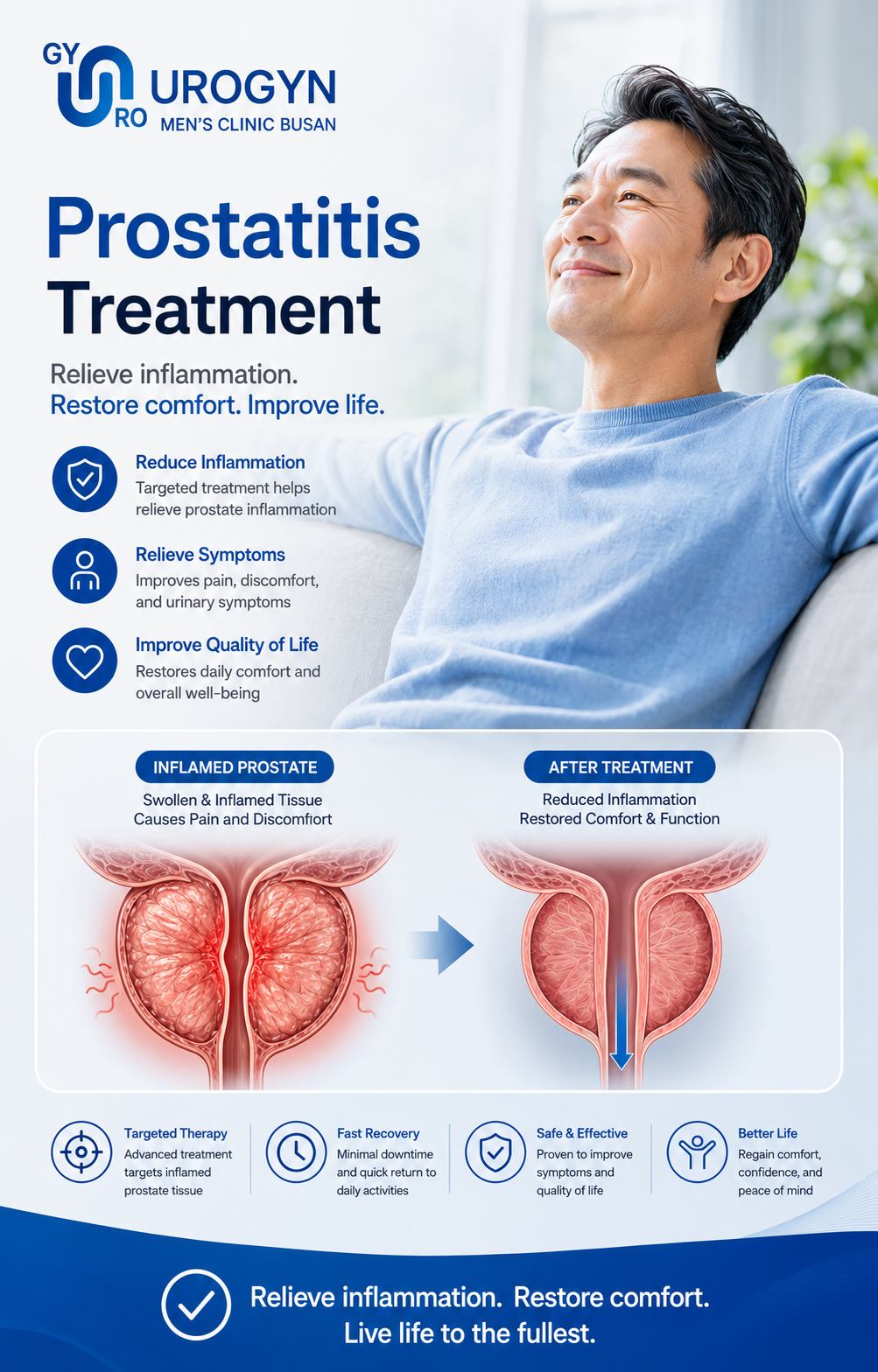
Prostatitis Treatment in Busan
Inflammation behind many cases of blood in semen.

Elevated PSA — What Next?
The prostate question that often arrives alongside.
Painful Ejaculation
A frequent companion symptom and what it points to.

BPH Warning Signs
When prostate enlargement is the source of bleeding.
Urogyn Men's Clinic, Seomyeon
7F-702, Ion City Building, 74 Seomyeon-ro, Busanjin-gu, Busan 47299 — one minute on foot from Seomyeon Station Exit 7 (Lines 1 & 2).
Mon–Fri 10:00–18:00 · Sat 10:00–14:00 · Sun closed
부산광역시 부산진구 서면로 74 아이온시티빌딩 7층 702호 — show this to your taxi driver.
Tell us which it is and when. We will say how soon to come.
Semen or urine, when you noticed it, whether it recurred, your age and whether you smoke are enough for our urologist in Busan to say how urgently to be seen and which tests to run first.